










After a difficult 2024 and 2025, the market for smart conveyance technology (SCT) is showing early signs of recovery. New research from market intelligence firm Interact Analysis forecasts that linear SCT revenue will more than double to over $1.2 billion by 2031, while planar systems are set to grow more than sixfold as they move from pilot projects into commercial production.
Smart conveyance systems replace fixed mechanical transport with independently controlled carriers. In linear systems, direct-drive linear motors move multiple carriers along straight or curved tracks. Planar systems go a step further, letting carriers travel freely across two horizontal axes; some can also tilt, rotate or make small vertical movements. The report, which covers technologies also known as independent carts, flexible transport systems or multi-carrier motion systems, draws on primary research, supplier reporting and the company’s Manufacturing Industry Output Tracker.
Linear SCT: from slowdown to steady growth
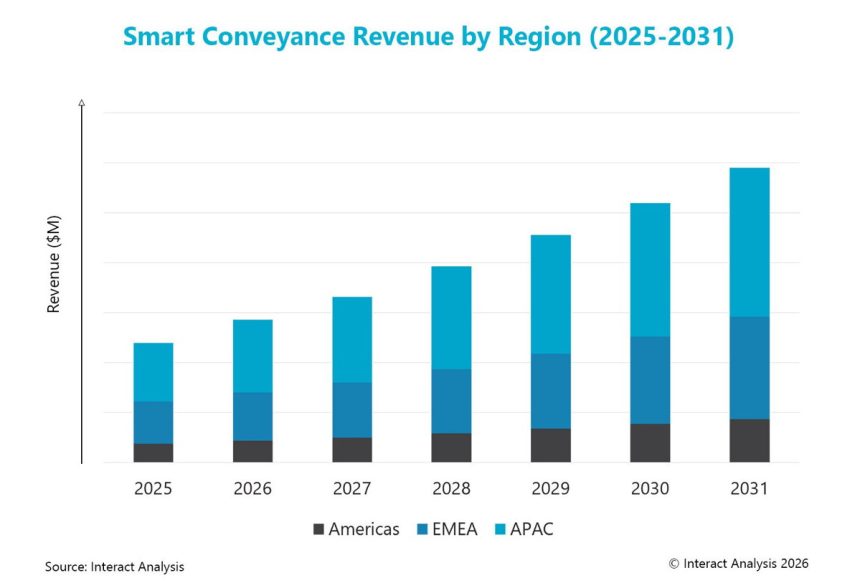
Global linear SCT revenue stood at $477.5 million in 2025. Weakness across the wider industrial automation sector kept conditions difficult for most of the year, but order intake started to pick up towards year-end, which Interact Analysis sees as an early signal of a better 2026.
Over the forecast period, the firm expects linear SCT to grow at an average of 16% a year, reaching more than $1.2 billion by 2031. Volatility should remain moderate as new suppliers enter the market and applications diversify. The market is also increasingly segmented by payload, with demand gradually shifting toward heavier loads and more technically demanding uses.
Planar SCT enters its commercial phase
Planar SCT revenue is forecast to rise from $33.4 million in 2025 to $218.4 million in 2031. According to the research, 2024 was the turning point for planar motor technology, as early pilot programmes began converting into commercial deployments and new projects followed. A broadening range of applications, an evolving competitive landscape and rising customer adoption are expected to sustain growth. The high upfront cost of these systems, and the difficulty of demonstrating sufficient return on investment, remains the main barrier.
Regional picture: APAC leads linear, EMEA leads planar
Asia-Pacific outperformed the Americas and EMEA in 2025 and remained the largest market for linear SCT, with revenue of $234.3 million. Investment in battery production, semiconductors and electronics, together with domestic industrial automation, supported demand. In the Americas and EMEA, cautious capital spending and slower investment in battery and automotive manufacturing held the linear market back.
The planar segment shows the opposite pattern. EMEA is currently its largest market, with revenue forecast to increase from $19.2 million in 2025 to $129.1 million in 2031. The Americas follow, rising from $13.3 million to $80.2 million, while APAC remains small, growing from $0.9 million to $9 million as commercial adoption gathers pace.
Clara Sipes, Market Analyst at Interact Analysis, said the long-term outlook remains resilient despite the tough conditions of 2025. She pointed to planar systems entering commercial production and growing demand for higher-payload linear systems as the key opportunities, with investment in battery manufacturing, semiconductors and electronics expected to drive adoption through 2031.
Source
- Interact Analysis, press release, 10 September 2026: Global smart conveyance technology market remains robust, with linear market more than doubling to $1.2bn by 2031
Image: Interact Analysis